
Blue Boar Hall, The Bower House and a walk through Havering Country Park
The Green down Orange Tree Hill and into Havering Country Park via Pinewood Avenue
On the edge of the village green, on the left as you face the church, is the oldest remaining building in the village, Blue Boar Hall. Documented in 1710, with parts dating from the 16th and 17th centuries, it was re-fronted in the 19th century. It is a timber framed house with a brick front, three windows wide, 2 storeys high. It has a large, stepped end stack on the west gable, a smaller brick stack on the front roof slope and sash windows to the front with cambered heads. Two small rear wings are also timbered framed. The Blue Boar was a public house for part of the 19th century.
Walking past Elmer Avenue, down Orange Tree Hill, you will notice the old cast iron lamp posts. At the entrance to Elmer Avenue there was an entrance pillar surviving from the Havering Park Estate. It was restored fairly recently before being flattened by a hit and run driver! It is too expensive to restore again.
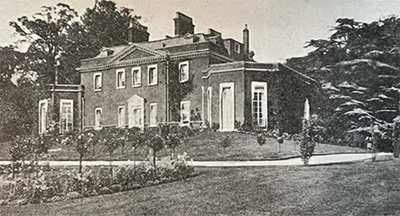
Continuing down Orange Tree Hill you come to the Bower House, originally called Monthavering and then later The Manor House. It was built for John Baynes, a barrister, in the Palladian style in 1729 by Henry Flitcroft. It was his first commission, with landscaping by Bridgeman. The stable block to the left of the main building, may have been designed by Flitcroft or Bridgeman. Inside there is a staircase which has echoes of Inigo Jones. The house, although small, shows us what a gentlemen’s home in the Georgian period looked like. John Baynes died in 1737. His monument in the church is the oldest there. The house is open to visitors during the London Open House Weekend.
Return to the Green via Pinewood Road, opposite the Orange Treen Pub, and through the country park via 5 ways, signposted. (Probably just under a mile).