
The Hall, Pemberton Roses, The Round House and The Water Tower
The Hall (Saint Francis Hospice) Facing the Hall from the Green you will notice the well-built yellow brick wall which passes right through the middle of the pond, known in recent times as the ducking pond, although no evidence has been found to verify it was ever used to duck people! Behind the wall, the hospice administrative offices are now housed in the Victorian mansion which was constructed in 1858/1859 replacing an earlier L shaped house on the site. It was last a home in 1975, lived in by Michael Heap’s family, when it was purchased by Saint Francis Hospice. New buildings were constructed adjacent to the original structure. The garden still has examples of many fine trees. From the Green you can see three huge London planes just to the left of the building and towering over it. They are the 5th tallest in Greater London and the tallest in Essex. There is one closer to you. In the garden behind the Hall is a 350 year old cork tree, the pride of Havering Council.
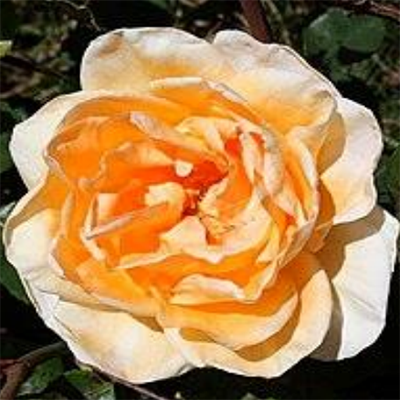
The last occupants Emily Ann Pemberton-Barnes died before the second world war. Reverend Joseph Hardwick Pemberton and his sister Florence, who lived in the Round House, visible behind the Hospice on the left down Broxhill Road, were the last occupants. They set out to breed the Pemberton Roses before, during and after the first world war. Ever mindful of his family home and the happiness of his childhood, he cherished his ‘Grandmother’s Roses’. On Sundays Joseph, his sister Florence and parents went to church dressed in their Sunday best. A fellow parishioner always wore a black cloak and a fresh rose buttonhole which Joseph much admired. Every Sunday morning, he would search the garden for a rose to wear in his button hole which would outdo the gentleman’s. When Joseph was sent to boarding school, he liked to take with him some memento of home and he would frequently take a rose in an empty barley sugar tin. When Joseph was about 12 his father taught him how to propagate a rose by budding and he was given his own patch of garden with red standard roses. Joseph’s aim was to breed such varieties with the intention that they should out bloom his grandmother’s, most of which were finished for the season by July. His aim was to breed roses that flowered as long as the winter allowed, even up to Christmas Day. He wanted roses which would survive and bloom after all around them had perished. He originated a group of varieties which he called Hybrid Musks, large bushes, in bloom more or less continuously. Their flowers vary in size and doubleness, mostly white, pale pink and pale yellow in gigantic clusters. There are 81 listed varieties of the Pemberton Rose. His reputation is considerable.
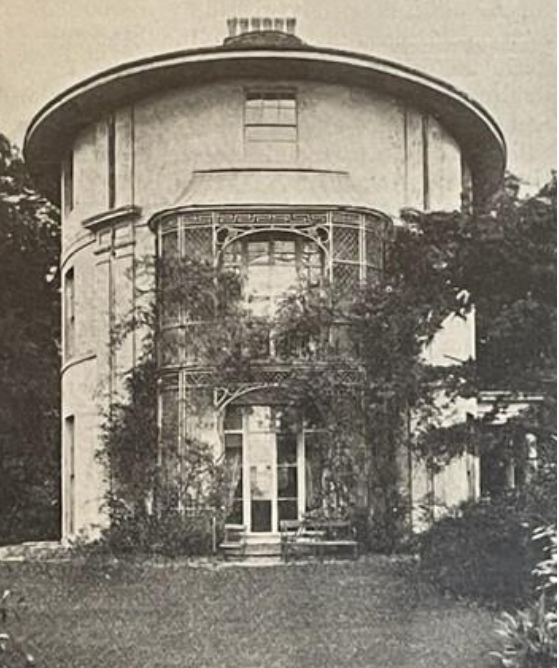
A short walk down Broxhill Road on the left and hidden behind a holly hedge is The Round House last occupied, historically, by Reverend Joseph Pemberton and his sister Florence. The Round House, named because of its circular form, was erected by William Sheldon. There is a story that the house was built by a retired tea dealer in the shape of a tea canister, to commemorate how he had made his money. The story may, however, be just a story. It was sold to William Jacobs in 1807 who bequeathed it to his wife’s niece Mary the wife of William Whitehurst . Mr Sheldon owned a lot of properties in the village but did not live here. However, Mr Whitehurst was Chapel Warden in 1827-8 and it was his resolution that a desk, benches, books and other equipment be provided for use by the school. In 1833/34 the Round House was purchased by Mr John Barnes who left it to his wife who, in turn, left it to her second daughter Amelia, the wife of Joseph Pemberton. Joseph’s son, Reverend Joseph Pemberton is the well-known rose grower. It remains a private dwelling.
The Water Tower, clearly visible on the left further down Broxhill Road, was built in 1934 to give sufficient water pressure to the buildings on the hilltop. It is still working as a water tower. When the land was provided by the Pemberton Barnes family for its construction, it was a condition that it should always be as you see it now, a remarkably attractive concrete structure, a landmark visible for miles around. During the war it was used by German bombers to guide them to and from London. As well as being the location of the air raid siren, it was used for years for radio transmissions by the armed forces.
The Pemberton family also provided the grounds for the village cricket club. On the right, The lie of the land around the pitch is interesting. There is some evidence to indicate that this may be an ancient construction, perhaps even a fort from the Iron Age or Roman times. It is hard to imagine the Romans not living in a village with the control this would give from the high hill overlooking the main road from London through Romford to Brentwood and Colchester.
From the far side of the cricket pitch, and from the visitor centre in Bedford’s Park, the views to the South are some of the finest in Essex or London. On a clear day you can see the Dartford bridge on the horizon at the left, the river Thames in the distance – and occasionally a tall ship on it. You can also see Shooters Hill in South London then further to the right the Millennium dome, O2, before coming to the pyramidally topped Canary Wharf.