
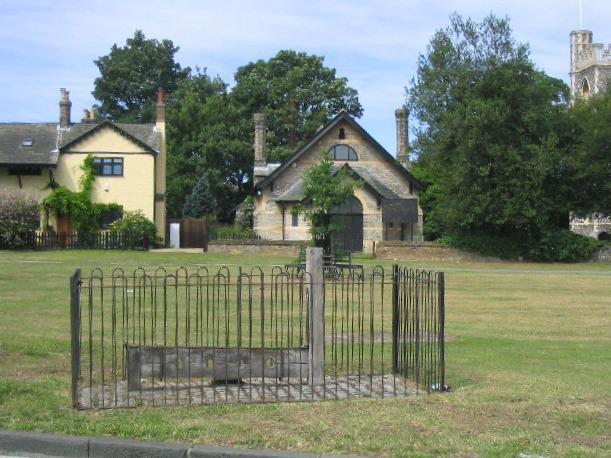
On the corner of the village green are the village stocks which were being used in the seventeenth century and still being used in the nineteenth as a means of punishment for small time criminals. Just beside the stocks is the village sign the design of which alludes to the history of the village. The sign was unveiled by Boris Johnson when he was Mayor of London. There were originally two palaces. One situated just at the rear of the church and used by royalty till 1638 when it became uninhabitable due, apparently, to the stench from the latrines, is perhaps correctly described as The Royal Manor and Park but is commonly known as Havering Palace. The mainly timber construction was associated with late Saxon kings, particularly Edward the Confessor, who may have used it as a place of retreat. There is a legend that Edward, disturbed in his devotions by the singing of nightingales, prayed that
these should be banished from the park forever.
Along the north side of the Village Green is an interesting row of houses, once businesses. The timber framed buildings date from the late 18th century. On the corner was the blacksmith’s workshop. The last incumbent was Con Rowland, a great village character. Con doubled up as the village postman but, well-oiled with drink, not all the letters reached their destinations
without mishap! His son, Derek, who is a historian and has written a book about the village, lived in the house till recently. Next door and facing the Green used to be Knightsbridge the butcher. Established in 1875, a butcher of the highest quality with slaughterhouse at the rear, customers travelled from far and wide. Sadly when the time came for the brothers to retire, modern health and safety requirements made it no longer practical to maintain a slaughterhouse in this location. After a short time as a craft shop and tearoom, the building is now a private home as, indeed, is every one of the remainder of the buildings around the
village green with the exception of the Church, Church Hall and Saint Francis Hospice.
Proceeding down North Road you come to The Royal Oak pub which is, sadly, waiting for new owners. The pub was first licenced in 1744 but given up in 1792. It reopened in 1920 and has been the centre of the village until very recently. From 2003 it incorporated an Indian restaurant which was a great benefit to the local community. The restaurant has moved to Stapleford Abbots Golf Club.
Further down the hill on the left, Ivy Holt is a double pile house, a technical term meaning two rooms deep, built in the early 19th century. It displays an elegant façade with a pretty and functional arcade canopy. Although she may have lived in an earlier building on the same site, the house is known as the home of Elizabeth Balls, ‘the Goat Woman of Havering-atte-Bower’. In 1814 she kept 32 goats; in the following year she shared her house with 14 goats, 2 sheep, 17 fowl and a French dog. The travel guides of the day emphasised that she was a ‘gentlewoman’. She kept a horse and a little cart in which she drove herself to Romford to buy hay for the goats. Somewhat reclusive, she only allowed one person into her home, about twice a year, in order to clean up after her extended animal family. A newspaper article in the 1950’s reported a motorist sighting a ghostly apparition of goats crossing North Road near Ivy Holt and that a strong smell of goats permeated the walls and ground floor of the house. The allegation is strongly denied by the current incumbents!
Next door Dame Tipping School, founded by Dame Tipping of Pyrgo, and in 1724 according to the inscription on the wall, remains a traditional village school, originally serving children of all ages but now just those up to 11.
Dame Ann Tipping inherited the estate of Pyrgo from her father, Colonel Sir Thomas Cheek of Pyrgo, Governor of the Tower of London in the Reign of King Charles II. In her will Dame Ann provided for a charge of £10 per annum on the Pyrgo estate for the perpetual education of 20 poor children. The first school was held on The Green, close to the Vicarage. It is probable that the vicar was also the schoolmaster. In 1791 it is recorded that ‘John Fosbrook M.A, is master of the free school and perpetual curate of Havering-atte-Bower’.
In 1818, because the school was dilapidated, it was pulled down. However, in 1837 an enthusiastic new vicar started a fund to rebuild the school. He set up a public subscription list and took collections in Church. School records show that the contributors to the rebuilding fund not only included local dignitaries and landowners, but also young Queen Victoria and the Queen Dowager, Adelaide, widow of William IVth. The school was rebuilt on its current site.
The new school opened on 2nd October 1837. Around 1874, an infant school was held separately in a cottage on The Green but this was amalgamated with the main school in 1880. The school was considerably enlarged in 1891, the building you see now, when it provided education for one hundred and twenty six children.
Returning back to The Green you will pass Rose Cottage on the left. It is a grade II listed building constructed with a timber frame, weatherboarding and reused medieval material in the 16th or early 17th century. In 1924 the Mason family opened a sweet shop here which then expanded to become a general stores with teas served in the adjoining garden. Finally, in 1928 Rose Cottage also became the village Post Office which stayed open for 39 years. The shop eventually closed in 1970 and Rose Cottage became a residential property. The new owners made such a good job of renovating the house that Rose Cottage won an environmental award in 1984, detailed on the plaque by the front door.
Ivy Mason had Redstock Cottage built on the plot of land next door, originally part of Rose Cottage Garden. Ivy had difficulty moving about and lived on the ground floor only. The upper floor was left unfinished as an attic space. Ivy sadly passed away in the 1990’s.